Employers Liability Insurance Standalone Policy Options
Employers Liability Insurance Standalone Policy Options: A Comprehensive Guide for Business Owners
Imagine this: One of your employees suffers a serious injury on the job. Workers’ compensation kicks in to cover medical bills and lost wages—no questions asked about fault. But then the employee sues your company, claiming negligence led to additional suffering, like pain and emotional distress, that workers’ comp doesn’t address. Suddenly, you’re facing hefty legal fees, settlements, and judgments that could cripple your business. This is where employers liability insurance standalone policy options come into play, providing that critical extra layer of protection.
As a business owner, navigating insurance can feel overwhelming, but understanding employers liability insurance (often abbreviated as EL or ELI) is essential for safeguarding your company’s financial health. While it’s commonly bundled with workers’ compensation, standalone options exist for specific situations, offering flexibility and targeted coverage. In this guide, we’ll break down everything you need to know in plain language, from basics to real-world applications, so you can make informed decisions.

What Is Employers Liability Insurance and Why Do You Need It?
Employers liability insurance protects your business from lawsuits filed by employees (or their families) over work-related injuries or illnesses that go beyond standard workers’ compensation benefits. It’s designed to cover claims alleging employer negligence, where damages include pain and suffering, loss of consortium (impact on family relationships), or consequential injuries.
Unlike workers’ compensation, which is a no-fault system providing statutory benefits like medical care and partial wage replacement, employers liability steps in for liability-based claims. It’s often called “Part Two” of a workers’ compensation policy because it complements “Part One” (the workers’ comp portion).
Key reasons businesses need it:
- Workers’ comp has limits—it doesn’t cover punitive damages, emotional distress, or certain third-party-related suits.
- Without it, you’d pay legal defense costs, settlements, and judgments out of pocket.
- It enhances credibility with stakeholders and helps comply with multi-state operations.
Semantic terms like stop-gap coverage, employer liability stop-gap, or monopolistic state employers liability often refer to standalone versions needed in certain scenarios.
For broader protection, pair it with other policies. Check out our guides on business insurance basics or professional liability insurance for complementary options.
The Difference Between Employers Liability Insurance and Workers’ Compensation
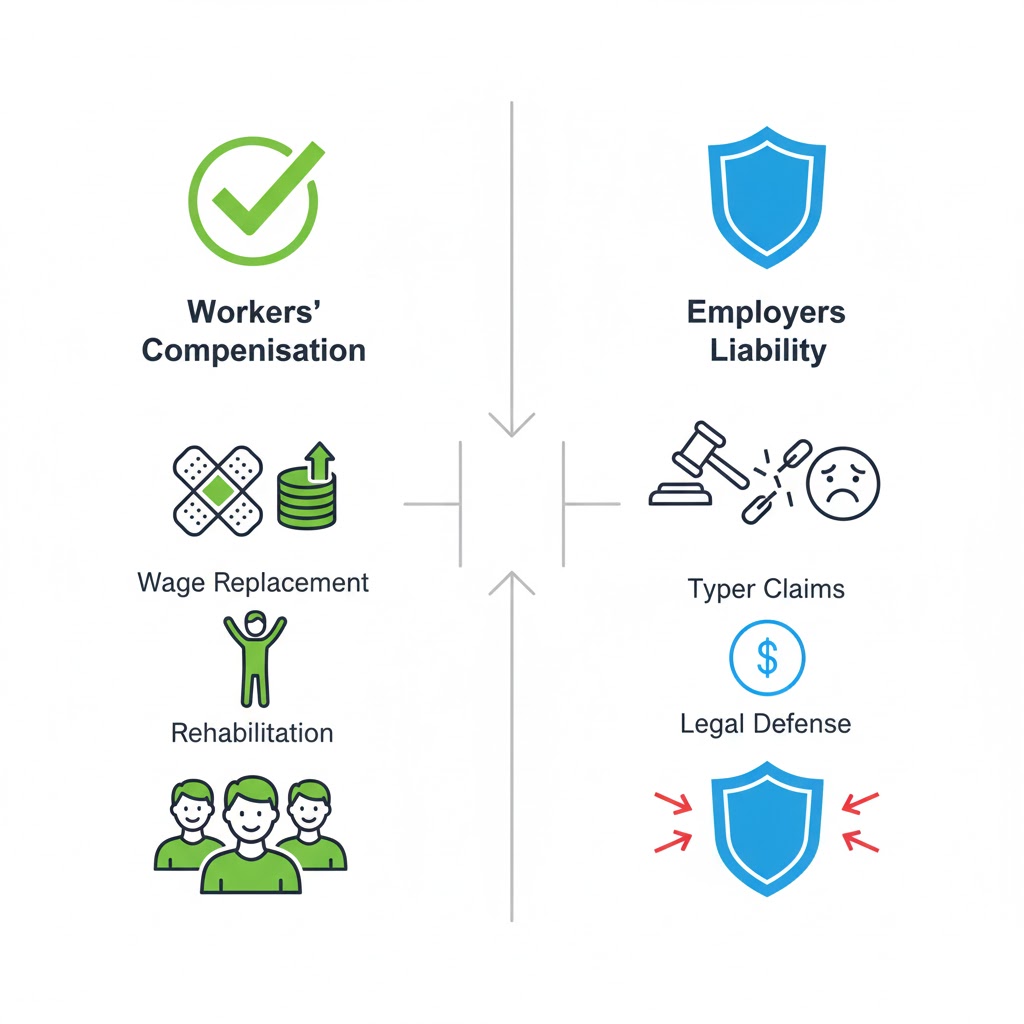
These two coverages work hand-in-hand but serve distinct purposes. Here’s a clear comparison:
| Aspect | Workers’ Compensation (Part One) | Employers Liability Insurance (Part Two) |
|---|---|---|
| Fault Requirement | No-fault: Benefits paid regardless of blame | Fault-based: Covers lawsuits alleging employer negligence |
| What It Covers | Medical bills, lost wages, rehabilitation, death benefits | Legal defense, settlements, judgments for pain/suffering, third-party over suits, dual-capacity claims |
| Typical Inclusion | Required in most states; statutory benefits | Usually bundled, but standalone in monopolistic states |
| Limits | No dollar limits on benefits | Structured limits (e.g., $100,000 per employee) |
| Exclusions | Doesn’t protect employer from lawsuits | Doesn’t cover discrimination/harassment (needs EPLI) |
In short, workers’ comp protects employees quickly and directly, while employers liability shields your business from escalating legal risks.
When Do You Need Standalone Employers Liability Insurance Options?
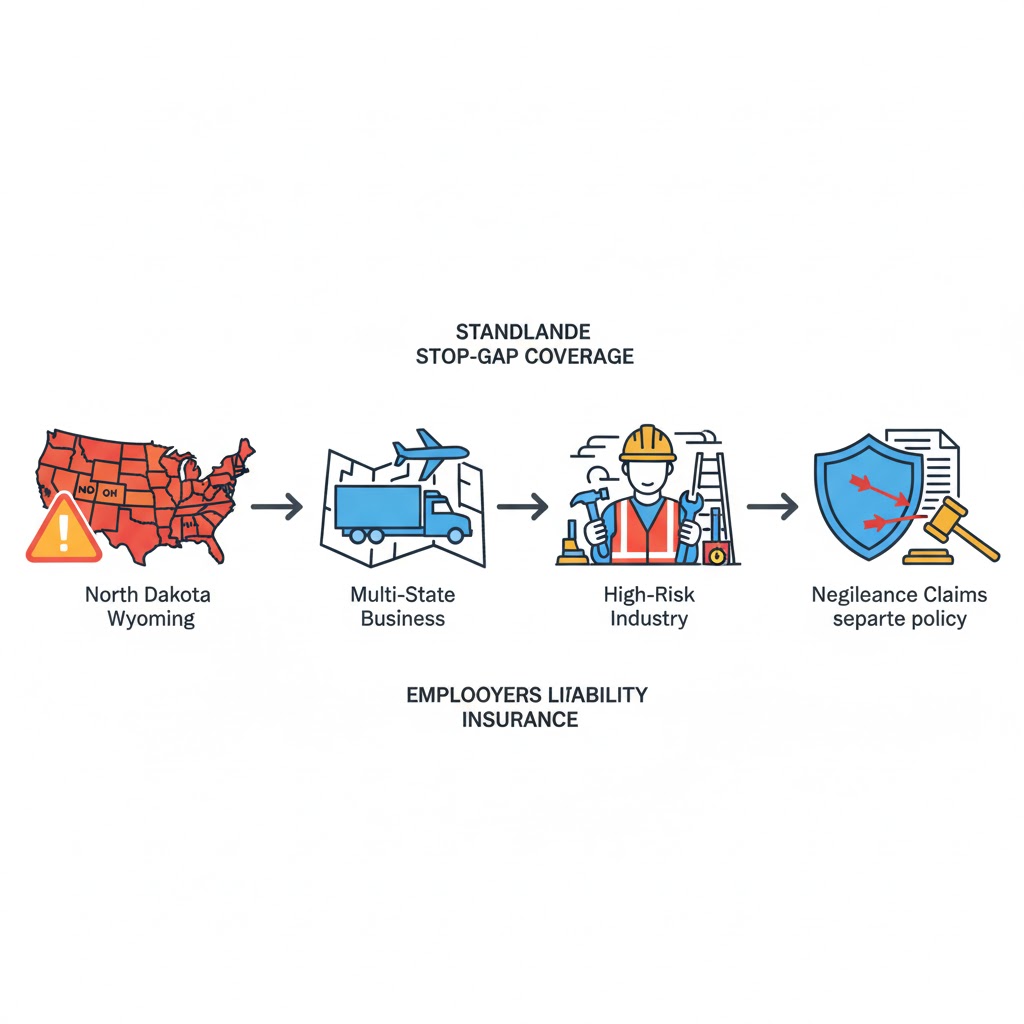
In most states, employers liability is automatically included in private workers’ compensation policies. However, standalone employers liability insurance (also known as stop-gap coverage) becomes necessary in specific cases:
Monopolistic States
Four states—North Dakota, Ohio, Washington, and Wyoming—require workers’ comp through exclusive state funds. These funds do not include employers liability coverage. If your business operates in or has employees in these states, you must purchase standalone EL, often as an endorsement to general liability or a separate policy.
Multi-State Operations
If you have workers’ comp in non-monopolistic states but employees traveling to or working in monopolistic ones, standalone stop-gap fills the gap.
High-Risk Industries or Custom Needs
Businesses in construction, manufacturing, or transportation may opt for standalone higher limits if bundled coverage falls short.
Real-life statistic: The U.S. Bureau of Labor Statistics reports millions of workplace injuries annually, with some leading to lawsuits exceeding workers’ comp benefits.
What Does Employers Liability Insurance Cover (and What Doesn’t)?
Coverage typically includes:
- Bodily injury by accident: Defense costs and damages for negligence claims.
- Bodily injury by disease: Occupational illnesses.
- Third-party over actions: When an injured employee sues a third party, who then sues your business.
- Dual-capacity suits: Rare cases where you’re sued as both employer and another role (e.g., equipment manufacturer).
- Consequential bodily injury: Family member claims (e.g., spouse contracting illness from employee).
Common exclusions:
- Intentional acts or criminal behavior.
- Claims covered fully by workers’ comp.
- Employment practices issues like discrimination (covered by EPLI).
- Injuries to independent contractors or non-U.S. employees.
Always review policy details—coverage varies by provider.
Coverage Limits and How to Choose the Right Ones
Standard limits are often structured as three figures:
- Per employee (e.g., $100,000): Max payout for one worker’s claim.
- Per accident (e.g., $100,000): For a single incident affecting multiple employees.
- Policy aggregate (e.g., $500,000): Total limit for all claims in the policy period.
Many businesses start with $100,000/$100,000/$500,000 but increase to $500,000/$500,000/$1,000,000 or higher for greater protection, especially in high-risk sectors.
Example 1: Basic Limit Scenario
A small office-based business with low risk might stick to standard $100k/$100k/$500k limits. Annual cost addition: Minimal, often under $500 when bundled.
Why relevant: Low-exposure businesses (e.g., consulting firms) save on premiums while meeting requirements.
Example 2: Increased Limits for Construction Firm
A 50-employee construction company in a multi-state operation opts for $1M/$1M/$1M limits.
Step-by-step calculation:
- Base workers’ comp premium: Say $50,000 (based on payroll and class codes).
- Increased limits factor: Many carriers use tables (e.g., 5-10% uplift for doubling limits).
- Added cost: Approximately $2,500–$5,000 annually.
Why relevant: Construction faces higher lawsuit risks; higher limits prevent out-of-pocket exposure.
Example 3: Standalone Stop-Gap in Monopolistic State
An Ohio-based manufacturer with $1M payroll buys state fund workers’ comp (no EL included) and adds standalone EL at $500k/$500k/$500k.
Estimated premium: 0.5–2% of payroll, or $5,000–$20,000/year, depending on risk class.
Why relevant: Ensures compliance and protection without overpaying for unnecessary bundled features.
Encourage testing scenarios: Adjust your payroll, industry, or limits in quotes from multiple providers to see cost variations—small changes can save thousands.
Cost of Employers Liability Insurance Standalone Options
Costs vary widely:
- Bundled with workers’ comp: Often $500–$2,000 annually for small businesses.
- Standalone/stop-gap: $1,000–$10,000+ for mid-sized firms, influenced by payroll, industry, claims history, and limits.
Factors driving premiums:
- Payroll size and employee count.
- Industry risk (e.g., higher for manufacturing vs. office work).
- Location (monopolistic states may increase standalone needs).
- Claims history.
Average small business workers’ comp (including EL): Around $540/year, per industry data.
Top Providers for Standalone Employers Liability Policies
Major carriers offering flexible standalone or stop-gap options include:
- The Hartford: Strong for separate policies in monopolistic states.
- Chubb: High limits and industry-specific expertise.
- Travelers: Flexible endorsements.
- Progressive Commercial: Add-ons to general liability.
- Others like Insureon brokers for comparisons.
Shop multiple quotes—differences can be significant.
For food-related businesses, see our guide on general liability for food trucks.
How to Get the Right Coverage: Step-by-Step
- Assess your operations: Multi-state? High-risk?
- Review state requirements (most mandate workers’ comp; EL implied or separate).
- Get quotes: Include payroll details and desired limits.
- Consider bundling for savings.
- Add endorsements for higher limits if needed.
Explore workers’ compensation rates for related insights.
FAQs About Employers Liability Insurance Standalone Policy Options
1. Is employers liability insurance required by law?
No direct federal mandate, but it’s effectively required via workers’ comp laws in most states. Standalone is mandatory for coverage gaps in monopolistic states.
2. Can I buy standalone employers liability without workers’ comp?
Rarely—it’s tied to workers’ comp, but stop-gap exists for state fund scenarios. Always consult an agent.
3. How much do higher limits cost?
Increasing from $100k/$100k/$500k to $1M/$1M/$1M might add 5–20% to your premium. Test quotes with different scenarios.
Extra tip: Regular safety training reduces claims, lowering future rates.
Conclusion
Employers liability insurance standalone policy options provide essential protection in situations where bundled coverage isn’t enough—particularly in monopolistic states or high-exposure operations. By understanding the differences from workers’ comp, key coverages, limits, and costs, you can tailor a policy that safeguards your business without unnecessary expense.
Don’t leave your company vulnerable to unexpected lawsuits. Compare quotes today, test different limit scenarios, and explore related resources like our complete business insurance guide. Your peace of mind—and financial stability—depend on it.