
Secure Your Future: A Comprehensive Guide to Loan Life Insurance in 2025
Imagine a life where you’ve worked tirelessly to build a comfortable home for your family, perhaps secured with a substantial mortgage. You have a car, maybe some student loans, and credit card balances—all part of modern life. Now, consider the unthinkable: what if you were suddenly no longer there to provide for your loved ones? Who would bear the burden of those outstanding debts? This isn’t a pleasant thought, but it’s a critical one for responsible financial planning. This is precisely where loan life insurance steps in, offering a crucial safety net that many overlook. In 2025, understanding how this vital form of protection works is more important than ever.
As a senior editor and SEO content strategist, I’ve seen firsthand the peace of mind that comes with robust financial planning. My aim with this comprehensive article is to demystify loan life insurance, providing you with the knowledge to make informed decisions for your family’s future. We’ll dive deep into what it is, how it works, its different forms, and whether it’s the right choice for your unique circumstances.
Table of Contents
Key Takeaways
- Loan life insurance is designed to pay off specific outstanding debts (like mortgages, car loans, or personal loans) if the borrower passes away, preventing the burden from falling on their family.
- There are two main types: decreasing term life insurance, which often covers larger debts like mortgages and whose coverage decreases over time, and credit life insurance, typically for smaller, specific debts like credit cards or personal loans.
- While it offers targeted protection, it’s crucial to compare it with traditional term life insurance, which often provides more flexibility and broader coverage for overall financial needs.
- The decision to purchase loan life insurance depends on individual circumstances, existing coverage, and the desire to protect specific assets or family members from debt.
- Always read the fine print, understand the policy’s payout structure, and compare options from multiple providers in 2025 to ensure you get the best fit for your needs.
Understanding Loan Life Insurance: Your Financial Safety Net

The concept of loan life insurance is elegantly simple: it’s a specific type of life insurance policy designed to cover the outstanding balance of a loan should the borrower die before the loan is fully repaid. Think of it as a protective shield for your debts, ensuring that your loved ones aren’t left with the financial strain of repaying your loans during an already difficult time.
From my experience, one of the biggest myths I encounter is that “all life insurance is the same.” This couldn’t be further from the truth. While a standard life insurance policy provides a lump sum to your beneficiaries, allowing them to use it as they see fit (including debt repayment), loan life insurance is explicitly earmarked for particular debts. This distinction is vital because it guarantees the debt will be cleared, rather than leaving the decision up to beneficiaries who might have other immediate needs.
Let me share a quick story. I once helped a family whose patriarch had passed away unexpectedly. He had a substantial mortgage and a few personal loans. Fortunately, he had purchased a decreasing term loan life insurance policy for his mortgage. The relief on his widow’s face when she realized the house was fully paid off, regardless of their family savings, was palpable. It removed an immense financial stressor, allowing her to focus on grieving and rebuilding, rather than worrying about foreclosure. This is the power of this specialized insurance.
In 2025, with economic uncertainties and fluctuating interest rates, ensuring your major debts are protected against unforeseen circumstances is a prudent financial move. It’s not about planning for failure, but planning for peace of mind.
What is Loan Life Insurance?
At its core, loan life insurance is a contract between you and an insurance company. You pay regular premiums, and in exchange, the insurer agrees to pay off a specified loan (or a portion of it) if you pass away during the policy term. The beneficiary of this policy is typically the lender, or in some cases, your estate, with a clear directive that the funds are used for the loan repayment.
It’s most commonly associated with significant liabilities like mortgages, hence terms like “mortgage protection insurance” often being used interchangeably. However, it can also extend to other types of secured or unsecured loans, such as car loans, student loans, or personal lines of credit.
How Does Loan Life Insurance Work?
The mechanics are straightforward:
- Policy Purchase: You purchase a policy linked to a specific loan. The coverage amount is initially equal to, or slightly higher than, your outstanding loan balance.
- Premium Payments: You pay regular premiums to the insurance company. These can be monthly, quarterly, or annually, depending on the policy terms.
- The Unforeseen Event: If you pass away while the policy is active and the loan is still outstanding, a claim is filed.
- Payout: The insurance company pays the outstanding balance directly to the lender (or to your beneficiaries with instructions to repay the loan). This ensures the debt is cleared, and your collateral (like your home or car) is secured for your family, free and clear.
It’s important to note that the coverage amount for many loan life insurance policies, particularly those for mortgages, often decreases over time. This is because as you repay your loan, your outstanding balance reduces, and the insurance coverage adjusts accordingly. This is a key differentiator from standard term life insurance, where the death benefit typically remains level throughout the policy term.
Is Loan Life Insurance Mandatory?
Generally speaking, no, loan life insurance is not mandatory in most jurisdictions or for most lenders in 2025. Lenders cannot legally require you to purchase it as a condition for granting a loan. However, they may offer it to you or recommend it, often as a convenient add-on.
While not mandatory, many individuals choose to purchase it for the specific peace of mind it offers regarding a particular debt. It removes ambiguity and ensures a specific asset, often a family home, remains with the family without additional financial strain.
Types of Loan Life Insurance and Their Specifics
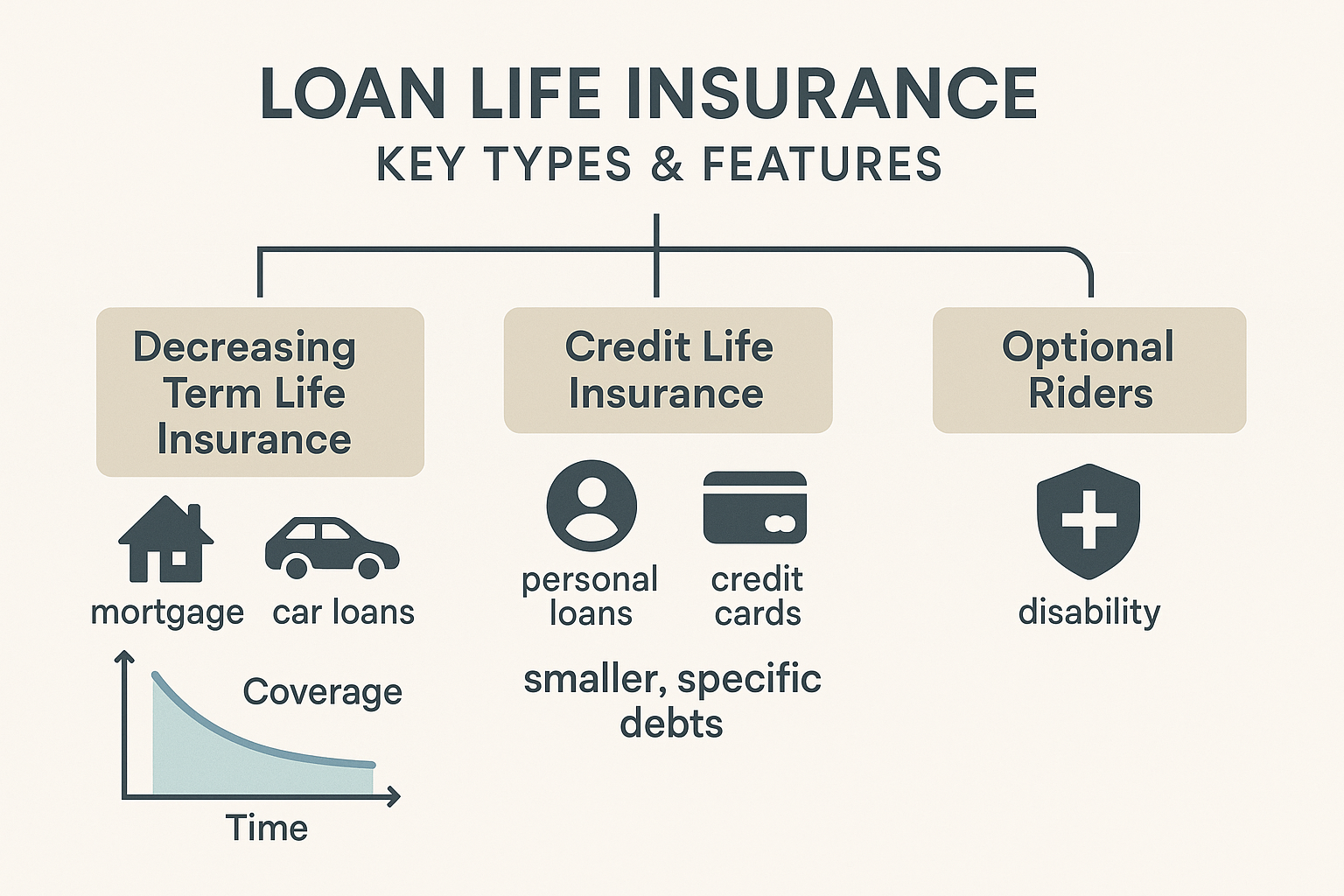
When we talk about loan life insurance, it’s not a monolithic product. There are distinct variations, each tailored to different types of debt and borrower needs. Understanding these nuances is crucial for making an informed decision. I’ve found that many people conflate these types, leading to confusion and sometimes, unsuitable coverage. Let’s break down the primary categories you’ll encounter in 2025.
Decreasing Term Life Insurance
This is perhaps the most common form of loan life insurance, especially for larger, long-term debts like mortgages.
- How it works: The death benefit of a decreasing term policy is designed to decline over the policy’s term, usually in step with the amortization schedule of your loan. As you pay down your mortgage principal, the amount the insurance company would pay out also decreases.
- Best suited for: Mortgages, large personal loans with fixed repayment schedules, or any long-term debt where the outstanding balance diminishes over time.
- Key features:
- Coverage aligns with debt: The primary benefit is that the coverage closely matches your remaining debt.
- Affordable premiums: Because the coverage amount decreases, the premiums are typically lower than those for a level term life insurance policy of the same initial face value.
- Specific purpose: The payout is explicitly intended to cover the loan balance, ensuring your family isn’t burdened by that specific debt.
- Example: Let’s say you take out a $300,000 mortgage in 2025. You could purchase a decreasing term loan life insurance policy for $300,000 for a 30-year term. If you pass away 10 years into the mortgage, and the outstanding balance is, say, $220,000, the policy would pay $220,000 to the lender to clear the debt.
One time, my colleague, Sarah, was hesitant about increasing her overall life insurance coverage but wanted to ensure her young family wouldn’t lose their newly purchased home if anything happened to her. A decreasing term policy for her mortgage was the perfect solution. It gave her targeted protection at a manageable premium, specifically addressing her biggest financial concern for her family.
Credit Life Insurance
Credit life insurance is another type of loan life insurance, but it’s generally applied to smaller, often unsecured, debts.
- How it works: This policy typically pays off a specific debt, such as a credit card balance, car loan, or personal loan, if you die. The benefit usually matches the outstanding balance of the particular credit account.
- Best suited for: Installment loans (car loans, student loans), credit card balances, or other smaller personal loans. It’s often offered by the lender directly when you take out the loan.
- Key features:
- Tied to a specific account: The coverage is directly linked to a particular loan or credit card.
- Convenience: Often easy to purchase directly through the lender at the time of loan origination.
- Limited scope: The coverage is highly specific and doesn’t provide general financial protection for your beneficiaries.
- Considerations: Premiums for credit life insurance can sometimes be higher relative to the amount of coverage compared to other life insurance options. It’s also often a single premium added to your loan, or a recurring charge based on your outstanding balance, which can be less transparent.
When considering credit life insurance, I always advise clients to scrutinize the cost. While convenient, it might not always be the most cost-effective way to cover smaller debts. Sometimes, a small, general term life policy can offer more flexibility for a similar premium.
Mortgage Protection Insurance (MPI)
While often used interchangeably with decreasing term life insurance, Mortgage Protection Insurance (MPI) can sometimes have additional features beyond just life insurance.
- How it works: MPI policies are specifically designed to cover your mortgage. They typically pay out a death benefit directly to the mortgage lender to pay off the remaining balance. Some MPI policies might also include disability riders, covering mortgage payments if you become unable to work due to illness or injury.
- Best suited for: Homeowners who want a dedicated policy to ensure their home is paid off for their family.
- Key features:
- Targeted for mortgages: Laser-focused on protecting your home.
- Optional disability/unemployment riders: Some policies offer additional protection against loss of income due to disability or unemployment, which can be a valuable add-on.
- No medical exam often: Some MPI policies are issued without a medical exam, making them accessible to those who might not qualify for traditional life insurance. However, this often comes with higher premiums.
My friend Mark, a self-employed graphic designer, opted for an MPI policy with a disability rider in 2025. His biggest concern was not just dying, but also becoming injured and unable to work, which would jeopardize his mortgage payments. The disability rider provided him immense peace of mind, knowing his home was protected even if he couldn’t work for an extended period. This highlights how some loan life insurance products can be customized to address multiple financial risks.
Making the Smart Choice: Loan Life Insurance vs. Traditional Life Insurance

The perennial question in the realm of debt protection is: “Should I get loan life insurance or just buy a regular term life insurance policy?” It’s a fantastic question, and one that deserves a thoughtful, nuanced answer, as there’s no single “right” answer for everyone. As an SEO strategist and editor, my goal is to equip you with the insights to make your best choice in 2025.
The Case for Loan Life Insurance
- Targeted Protection: The strongest argument for loan life insurance is its specific focus. It guarantees that a particular debt—like your mortgage—will be paid off. This removes any discretion from your beneficiaries, ensuring a roof remains over their heads or a car remains in the driveway without further financial burden.
- Simplicity and Convenience: Often, loan life insurance can be purchased directly through the lender, making the application process straightforward, sometimes without a medical exam (though this can affect premiums).
- Peace of Mind for Specific Debts: If your primary concern is ensuring a specific, large debt (like a mortgage) doesn’t fall to your family, loan life insurance delivers precisely that peace of mind.
- Accessibility: For individuals with health conditions who might struggle to qualify for traditional life insurance, some loan life insurance policies (especially MPI without medical exams) can be a viable option, albeit potentially at a higher cost.
I once worked with a couple, Maria and David, who were first-time homebuyers in their late 50s. David had a pre-existing health condition that made traditional, affordable term life insurance challenging to secure for a large amount. They chose a decreasing term loan life insurance policy for their mortgage. It wasn’t the cheapest option per dollar of coverage, but it provided the targeted protection they desperately wanted for their new home, and it was accessible.
The Case for Traditional Term Life Insurance
Traditional term life insurance provides a death benefit that is paid out to your chosen beneficiaries if you die within the policy term.
- Flexibility and Broader Coverage: This is the undisputed champion of traditional life insurance. Your beneficiaries receive a lump sum of money that they can use for any financial need: paying off debts (mortgage, credit cards, student loans), covering living expenses, funding education, or maintaining their lifestyle.
- Cost-Effectiveness (Often): For healthy individuals, a comparable amount of level term life insurance can often be more cost-effective per dollar of coverage than loan life insurance, especially credit life insurance. The premiums are typically fixed, and the death benefit doesn’t decrease.
- Greater Control: Your beneficiaries have full control over how the payout is used, allowing them to prioritize the most pressing financial needs at the time.
- Portability: Term life insurance is generally independent of your loan. If you refinance or change lenders, your policy remains active and unaffected. Loan life insurance is tied to a specific loan and may need to be re-evaluated or repurchased with a new loan.
Let’s revisit Sarah’s story. While she initially considered only decreasing term life for her mortgage, I encouraged her to also consider a traditional term life policy. We calculated her family’s overall financial needs: mortgage, living expenses for several years, college funds, and other debts. She ended up getting a combination: a smaller decreasing term for absolute mortgage certainty, and a larger, affordable traditional term policy to cover all other needs and provide general financial security. This blended approach gave her the best of both worlds.
Factors to Consider When Deciding
- Your Existing Coverage: Do you already have a robust term life insurance policy that would adequately cover all your debts and provide for your family’s living expenses? If so, additional loan life insurance might be redundant.
- Your Health and Age: If you’re young and healthy, traditional term life insurance is likely to be very affordable and offer broad protection. If you have pre-existing conditions, specialized loan life insurance that doesn’t require a medical exam might be an easier, though potentially more expensive, route for targeted protection.
- Specific Debt Concerns: Is there one particular debt that you absolutely must see paid off for your family’s sake (e.g., your mortgage)? If so, loan life insurance can provide that specific guarantee.
- Cost and Value: Always compare premiums and the total coverage amount. Get quotes for both options and calculate which provides the most value for your specific needs in 2025. Don’t forget to factor in any potential riders for disability or unemployment.
- Beneficiary Control: Do you want your beneficiaries to have flexibility with the payout, or do you want to ensure a specific debt is definitively cleared?
In my professional opinion, for most healthy individuals with dependents, a well-structured traditional term life insurance policy that covers all major debts plus income replacement is usually the more comprehensive and flexible solution. However, for those with specific concerns or who struggle to qualify for traditional insurance, loan life insurance serves a valuable niche. It’s about finding the balance that fits your personal financial philosophy.
Key Differences at a Glance (2025)
| Feature | Loan Life Insurance (e.g., Decreasing Term) | Traditional Term Life Insurance |
|---|---|---|
| Purpose | Specifically covers an outstanding loan balance. | Provides a lump sum to beneficiaries for any purpose. |
| Beneficiary | Often the lender; sometimes the estate for loan repayment. | Chosen beneficiaries (family, trust, etc.). |
| Coverage Amount | Decreases over time with the loan balance. | Usually remains level throughout the policy term. |
| Flexibility | Very specific, tied to a single loan. | Highly flexible, funds can be used as needed. |
| Portability | May need to be re-evaluated if loan changes. | Generally portable, independent of loans. |
| Medical Exam | Some policies (especially MPI) may not require one. | Typically requires a medical exam for underwriting. |
| Cost-Effectiveness | Can be higher per dollar of coverage for broad needs. | Often more cost-effective for general financial protection. |
Practical Steps for Evaluating Loan Life Insurance in 2025
So, you’ve weighed the pros and cons, understood the different types, and now you’re considering your options for loan life insurance in 2025. This section will guide you through the practical steps to evaluate whether it’s the right move for you and how to go about securing the best possible coverage. This is where the rubber meets the road, and smart decisions save future heartache and financial strain.
Step 1: Assess Your Current Debt Landscape
Before you even think about purchasing new insurance, take stock of what you already owe.
- List all major debts: Mortgage, car loans, student loans, personal loans, significant credit card balances.
- Note outstanding balances: Get the current figures for each.
- Understand repayment terms: How long until each loan is paid off? What are the monthly payments?
- Identify co-signers: Are any of your loans co-signed? If so, the co-signer would become solely responsible for the debt if something happened to you. This is a huge factor for consideration.
For example, when my cousin Mark was considering loan life insurance for his mortgage, he also had a substantial student loan. We realized that while the mortgage was his biggest concern, leaving his student loan debt to his wife would also be a significant burden. This led him to explore broader coverage beyond just the mortgage.
Step 2: Review Your Existing Life Insurance Coverage
Don’t buy new insurance in a vacuum. Look at what you already have.
- Employer-sponsored life insurance: Many companies offer basic life insurance. Is it sufficient? Is it portable if you leave your job?
- Individual policies: Do you have any existing term or whole life policies?
- Calculate total coverage: Add up all your existing death benefits.
- Determine if it’s enough: Compare your total coverage against your total debts plus the income replacement and future needs of your beneficiaries. A common rule of thumb is 7-10 times your annual salary, plus specific debt coverage.
If your existing life insurance already provides a sufficient death benefit to cover all your debts and support your family, then dedicated loan life insurance might be redundant.
Step 3: Compare Loan Life Insurance with Traditional Term Life Insurance
This is the most critical comparison. Get quotes for both.
- For Loan Life Insurance:
- Decreasing Term: Get quotes specifically for a decreasing term policy linked to your mortgage. Note the initial coverage, term length, and premium.
- Credit Life: If considering for smaller loans, compare the cost against the coverage amount. Pay attention to how premiums are structured (e.g., flat rate, or based on outstanding balance).
- For Traditional Term Life Insurance:
- Get quotes for a level term policy with a death benefit equal to (or greater than) your total outstanding debts plus any additional financial needs for your family.
- Compare the premiums for a similar term length (e.g., 15, 20, or 30 years).
- Consider different coverage amounts to see how premiums change.
Sometimes, a single traditional term life policy can provide more comprehensive protection for a similar or even lower premium than multiple specific loan life insurance policies. Use the interactive calculator below to help you compare.
Step 4: Understand the Fine Print
Regardless of the type of insurance you choose, reading the policy document is non-negotiable.
- Exclusions: What circumstances would prevent a payout? (e.g., suicide clause, specific risky activities).
- Waiting Periods: Are there any initial periods where coverage isn’t active?
- Beneficiary Designation: Who receives the payout? For loan life insurance, it’s often the lender, but for traditional life insurance, it’s crucial to name specific beneficiaries and contingent beneficiaries.
- Renewability/Convertibility: Can the policy be renewed at the end of the term? Can it be converted to a permanent policy?
- Riders: Are there any optional riders (like disability or critical illness) that might enhance the policy for your needs?
I vividly remember a client who bought what they thought was a comprehensive loan life insurance policy for their home. Only later did we discover it had a very restrictive definition of “total disability,” meaning it wouldn’t have covered their specific long-term illness. Always clarify these details before committing.
Step 5: Seek Professional Advice
This isn’t a decision you have to make alone.
- Independent Insurance Agent: An independent agent can provide quotes from multiple insurance companies for both loan life insurance and traditional life insurance, helping you compare options objectively. They are not tied to a single provider.
- Financial Advisor: A certified financial planner can help you assess your overall financial picture, including your debt, savings, and future goals, to determine the most appropriate insurance strategy.
In 2025, with so many options available online and through various providers, having an expert guide you can make a significant difference in securing the right coverage at the best value. Don’t hesitate to ask questions and seek clarity on anything you don’t understand. Your financial security—and your family’s—depends on it.
Conclusion
Navigating the world of insurance, especially specialized products like loan life insurance, can feel daunting. However, understanding its purpose, its different forms, and how it compares to broader financial protection is an essential step in securing your family’s financial future. In 2025, economic stability remains a top concern for many households, making debt protection more relevant than ever.
We’ve explored how loan life insurance acts as a targeted safeguard, ensuring specific debts, most notably your mortgage, are cleared if you’re no longer there to make payments. This singular focus can bring immense peace of mind, freeing your loved ones from the burden of complex financial decisions during a period of grief. We’ve also delved into its cousins—decreasing term life insurance and credit life insurance—each with its own niche in the debt protection landscape.
However, we’ve also emphasized the robust flexibility and often superior cost-effectiveness of traditional term life insurance for many individuals. A well-chosen term policy can not only cover your debts but also provide a substantial safety net for your family’s ongoing living expenses, education, and other future needs, offering a holistic approach to financial security.
Ultimately, the decision to purchase loan life insurance or opt for a traditional term life policy rests on your individual circumstances, risk tolerance, existing coverage, and the specific concerns you wish to address. There’s no one-size-fits-all answer, but by systematically assessing your debts, reviewing current policies, comparing options, and understanding the fine print, you can make an empowered choice.
Actionable Next Steps:
- Inventory Your Debts: Create a detailed list of all your outstanding loans and their current balances.
- Evaluate Existing Coverage: Review your current life insurance policies (employer-provided and individual) to understand your total death benefit.
- Calculate Your Needs: Determine how much coverage your family would genuinely need to cover all debts and ongoing living expenses for a significant period (e.g., 5-10 years).
- Get Quotes: Contact independent insurance agents or reputable online providers to get comparative quotes for both loan life insurance (especially decreasing term for your mortgage) and traditional term life insurance that matches your calculated needs.
- Consult a Professional: Discuss your findings with a trusted financial advisor or insurance professional in 2025. They can help you tailor a strategy that best fits your financial goals and family situation.
- Read the Fine Print: Always, always understand the terms, conditions, and exclusions of any policy before you commit.
By taking these proactive steps, you’re not just buying an insurance policy; you’re investing in your family’s future security and your own peace of mind. Make an informed decision that truly protects what matters most.
Loan Life Insurance vs. Term Life: Which is Right for You?
Use this calculator to estimate and compare the costs and benefits of hypothetical Loan Life Insurance and Traditional Term Life Insurance scenarios. This helps you visualize which option might better suit your financial protection needs in 2025.
Your Financial Profile
💡 **Consider this:** Traditional financial advice often suggests 7-10 years of income replacement for dependents.
Hypothetical Insurance Premiums
✍️ **Note:** These are hypothetical premiums. Actual quotes will vary based on age, health, policy type, and provider.
This calculator provides estimates for informational purposes only and should not be considered financial advice. Always consult with a qualified financial advisor or insurance professional to determine the best coverage for your individual needs in 2025.